How Often to Change Brake Fluid and How to Test It
Updated: · PRO SERVICE
How often to change brake fluid depends on its age, not mileage: every 2 years, or every 3 years on some brands such as Honda. Brake fluid pulls moisture out of the air, and in damp Batumi that happens faster than in a dry climate. After a couple of years it holds 2-3% water, the boiling point drops by 60-80 degrees, and on a long mountain descent the pedal can go to the floor.
Fluid ages even when the car sits
DOT 3, DOT 4 and DOT 5.1 are glycol-based. Glycol absorbs water through the reservoir cap, the rubber hoses and the seals. At 5,000 km a year or 30,000, moisture builds up at about the same rate. By the sea the air is humid nearly all year, so stretching the two-year interval here is a bad idea.
Why water in the brakes is a problem
Boiling. On a long downhill the pads and calipers heat up, the water in the fluid boils, and vapor forms in the lines. Vapor compresses, fluid doesn't. The pedal goes soft or sinks, and once things cool down it feels normal again. If that has happened even once on the road down from Khulo or the Goderdzi pass, the fluid needs replacing, no discussion.
Corrosion. Water rusts caliper pistons, the master cylinder and the ABS valves from the inside. A piston sticks and the pad drags all the time. An ABS unit is expensive, and old fluid is exactly what kills it.
DOT types and what mixes with what
| Class | Base | Dry boiling point, °C | Wet boiling point, °C |
|---|---|---|---|
| DOT 3 | glycol | 205 | 140 |
| DOT 4 | glycol | 230 | 155 |
| DOT 5.1 | glycol | 260 | 180 |
| DOT 5 | silicone | 260 | 180 |
These are the minimums under the standard. Good fluids boil higher.
DOT 3, 4 and 5.1 are compatible with each other. A mix performs like the weakest of them, so use the class printed on the reservoir cap or a higher one. Silicone DOT 5 doesn't mix with glycol fluids at all. You'll hardly ever find it in a regular passenger car, but don't confuse DOT 5 with DOT 5.1. Many cars with stability control need a low-viscosity DOT 4 (marked LV or Class 6). The owner's manual says so.
How to check your brake fluid
- Color. Fresh fluid is light amber. Dark fluid is definitely old, but light fluid isn't necessarily good.
- Tester pen. Measures conductivity and gives a rough water reading. At 2-3% or more, change it.
- Test strips. Show copper in the fluid, which means the corrosion inhibitors are used up and metal is dissolving.
- Boiling point tester. Heats a sample and shows the real boiling point. The most accurate method.
- Level. Drops slowly as the pads wear. If it drops fast, look for a leak.
How it should be done
Sucking the fluid out of the reservoir and topping up is quick, but the old fluid stays in the calipers and lines. The right way is to bleed each wheel in the order the manufacturer specifies until clean fluid comes out of the bleeder. A typical car takes about a liter. On some cars with ABS and stability control, the ABS unit is bled with a scan tool that runs the pump. On a manual with a hydraulic clutch, the clutch shares the same reservoir, so we change that fluid too.
An opened bottle that sat in the garage for a year isn't worth using. It has picked up water as well.
When to change it off schedule
- You bought a used car and don't know when it was last done.
- The pedal feels soft or slowly sinks under your foot.
- A caliper, hose or master cylinder was replaced.
- You're heading into the mountains and the two years are almost up.
- A tester shows 2-3% water or more.
Where to change brake fluid in Batumi
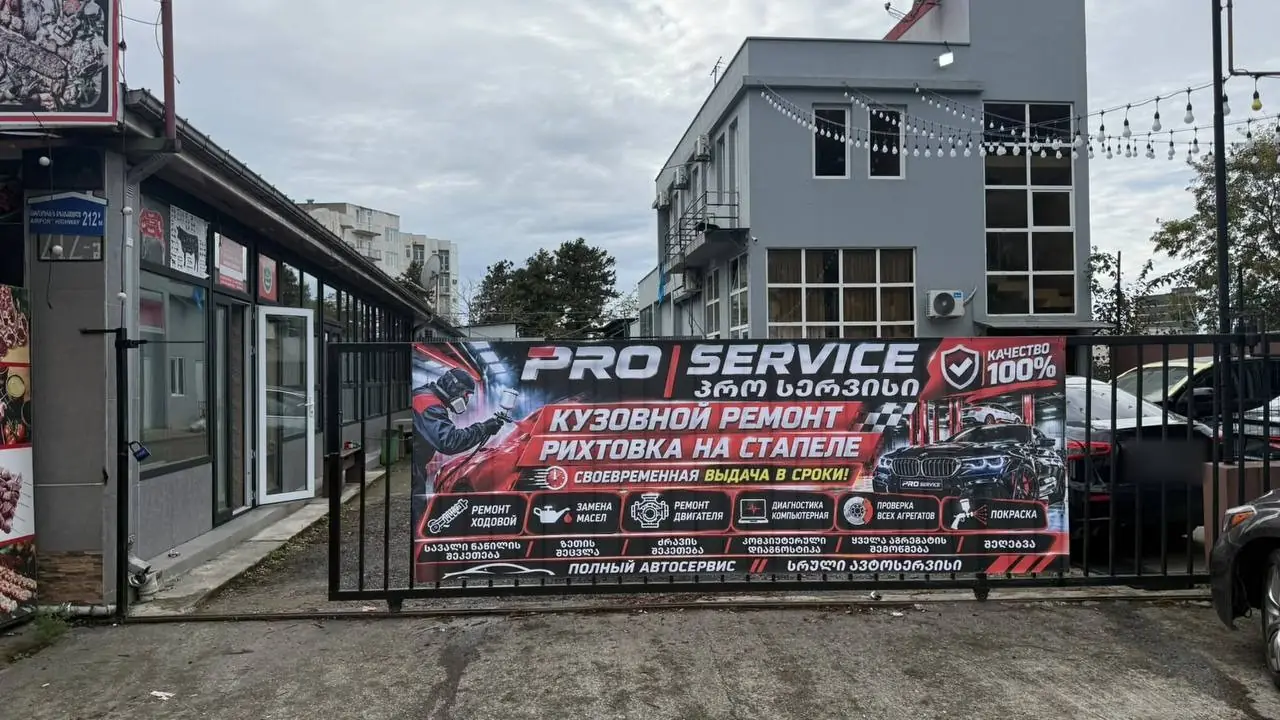
PRO SERVICE, Airport Highway 212M. Brake fluid replacement with every circuit bled, and we look at the pads and rotors on the same visit. If the brakes also squeal, read why brakes squeak, and for pad wear see when to replace brake pads.
FAQ
Can I just top it up to MAX?
You can top up with the same DOT, but that won't refresh the old fluid. The water stays in the system.
I'm getting new brake pads. Should I change the fluid too?
Not required, but if it's close to due, it's handy to do both in one visit. The wheels are off anyway.
Can I use DOT 4 instead of DOT 3?
Usually yes, it's a higher class. Not the other way around if the factory calls for DOT 4.
The level keeps dropping but I see no leak. Why?
The pads have worn down and the caliper pistons sit further out. If the level dropped suddenly, we check the hoses, calipers and master cylinder.
● 06 · Contact
Leave a request — we'll call back and book an inspection
Tell us what happened to the car. We'll call back, answer your questions and find a time. We give the exact price after an inspection: photos don't always show the damage.
By sending the request you accept the privacy policy.
Or message us — we reply right there:
- Address
- Airport Highway 212M, Batumi, Georgia
- Phone / WhatsApp / Telegram
- +995 599 66 66 75 · WhatsApp · Telegram
- Directions
- Google Maps ↗Yandex ↗Waze ↗